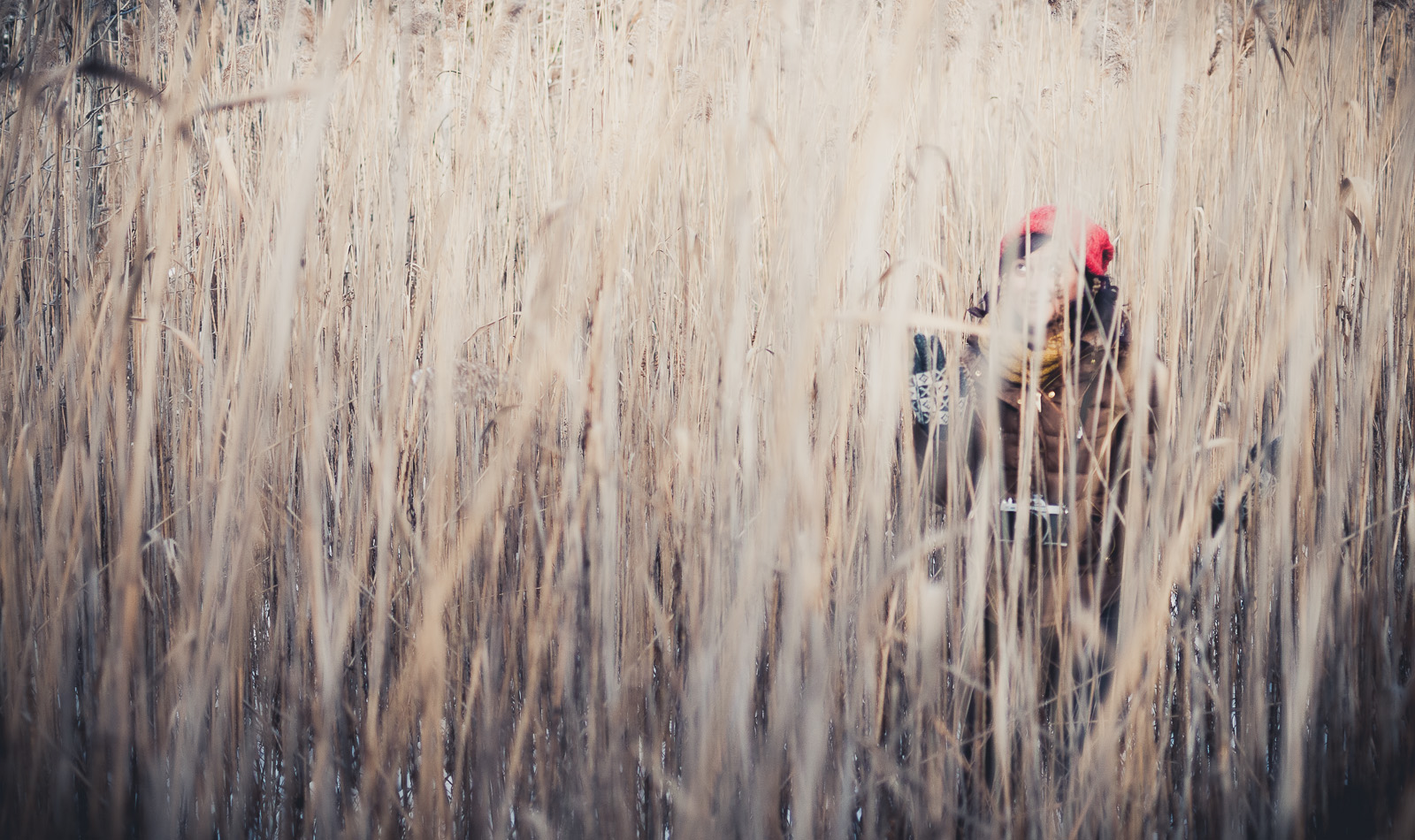
Nik and Erin’s Arboretum Engagement

This past October I had the privilege of taking engagement photos for my friends Nik and Erin. Both Nik and Erin are wonderfully fun people who smiled and laughed their way through the entire shoot. Their good chemistry was instantly obvious… and infectious. This was probably the first time I’ve ever had to direct people to take a break from smiling and flirting once in a while for a few more serious shots.

We started the day off at the University of Guelph Arboretum, where the trees were just hanging on to the last of their fall colours.

DSC_8331-Edit

The first image here is a bokeh panorama combining 30+ shots from the D7000 + Sigma 50mm f/1.4 at f/1.4. THe next three are from the D300s + AF-S 17-55 f/2.8.DSC_8592-EditDSC_8577-EditDSC_8638-EditAnd finally with the D300s + Tokina 50-135mm f/2.8DSC_8602-EditAfter the arboretum we headed down Gordon St. to the river and Guelph’s beautiful covered pedestrian bridge. First, with the D300s + AF-S 17-55mm f/2.8: DSC_8734-EditAnd finally another bokeh panorama with the D7000 + Sigma 50mm f/1.4.
DSC_8477-EditYour thoughts?

An Oldie but a Goodie

Here is a photo that I took a few years ago (June, 2008, to be specific) of my friend Elsa as part of a series of art for her upcoming album. Elsa wanted an “ethereal” feel and dressed accordingly. After taking a few in the garden and another few under a tree (with a lamb!) we saw that the sky was rapidly darkening. As the clouds rolled in and claps of thunder were heard in the distance I made the snap decision for us to hop over the fence an up into the field.2549214861_b348e08ffe_oWe had two lights with us, Vivitar 285HV, and cheapo ebay triggers for firing them. I set them up in a simple arrangement with the main light at camera right and the other at camera left to act as a rim. This second light can be seen at the left of the frame. I set the camera (K10D) to manual, 1/80s, f/6.3, ISO 160 to get the ambient exposure how I wanted it (1/2-1 stops underexposed) and adjusted the flashes to either 1/2 or full power. The lens, a Pentax DA 16-45/4 was zoomed out to 16mm.

A few quick snaps later and we were happy… and just in time, because as soon as we packed up the skies opened up and it rained like you wouldn’t believe!

Thoughts?

Lighting Candid Photos with Handheld Flash

When photographing candids in a dark environment, there are many options for lighting. One could choose to use the camera’s built-in flash, but that gives harsh shadows and terrible red eye. Adding a speedlight (flash) to the hotshoe and firing it directly moves the light source a bit off axis, but shadows are still harsh and red eye is still a risk. Diffusing the light, say with a Gary Fong Lightsphere or a Lumiquest Softbox (both of which mount directly to the head of the shoe-mounted flash), helps too. However, the light is still on axis.

A very common solution, and one which I often use, is to tilt the strobe head up and bounce it from a ceiling or wall. This effectively provides a large off-axis light source, giving a very soft fill. However, if the ceiling is quite high, non-white, or not there at all bouncing just won’t work. Even if bouncing does work, the fill is still quite soft and undramatic.

A lighting solution that I’ve been working with for the past while is to hold the flash in one hand while shooting with the other. I put a diffusion on the flash, usually a Lumiquest Softbox LTz and hold it with my left arm outstretched at about 30 degrees from horizontal. This method gives soft (but not too soft) off-axis light that is easily under my control.DSC_8341I trigger the flash (Nikon SB-900 or SB-700) using Nikon’s CLS (Creative Lighting System). I set the camera’s built-in flash as a “controller” so that it will control remote flashes but not add to the exposure. If I had set it to be a “master” it would fire as part of the exposure. I then set the handheld flash to be a remote, making sure that both it and the built-in flash are set to the same channel and group. (Note: Nikon CLS isn’t actually that complicated once you figure out all of the terminology. I found this site to be extremely useful.)

DSC_8347Of course, having more than one light source usually improves a photo even more. In the case of a wedding I did this fall in a barn, the light shining through the windows and poking through cracks in the wall provided an excellent backlight to complement the light from my flash.DSC_6378DSC_6429 DSC_6436 DSC_6427Thanks for reading!

The Making of a Scary Basement Photos – Part 2 (Editing)

I’d like to follow up my previous post with a more detailed explanation of how I pieced the composite image together and achieved the final look. Certain aspects of Photoshop, or photo editing in general, may seem like black art but in this case the process is fairly straightforward. I use two common image editing programs:

  • Adobe Photoshop Lightroom 4 (currently at v4.3)
  • Adobe Photoshop CS5

As I mentioned in the last post I started the process of taking this image with the final product in mind, simplifying the editing process considerably.

DSC_9718-Edit-5The first step, as in all my post-production, was to import the images into Lightroom. For those who don’t know, Lightroom is an extremely versatile program that provides a near-complete workflow from import, sort, edit, print, upload plus simple tools for generating slide shows, webpages and books. I do 95% of my editing in Lightroom and usually only go to Photoshop for complicated edits like cloning and healing or anything where layers are required.

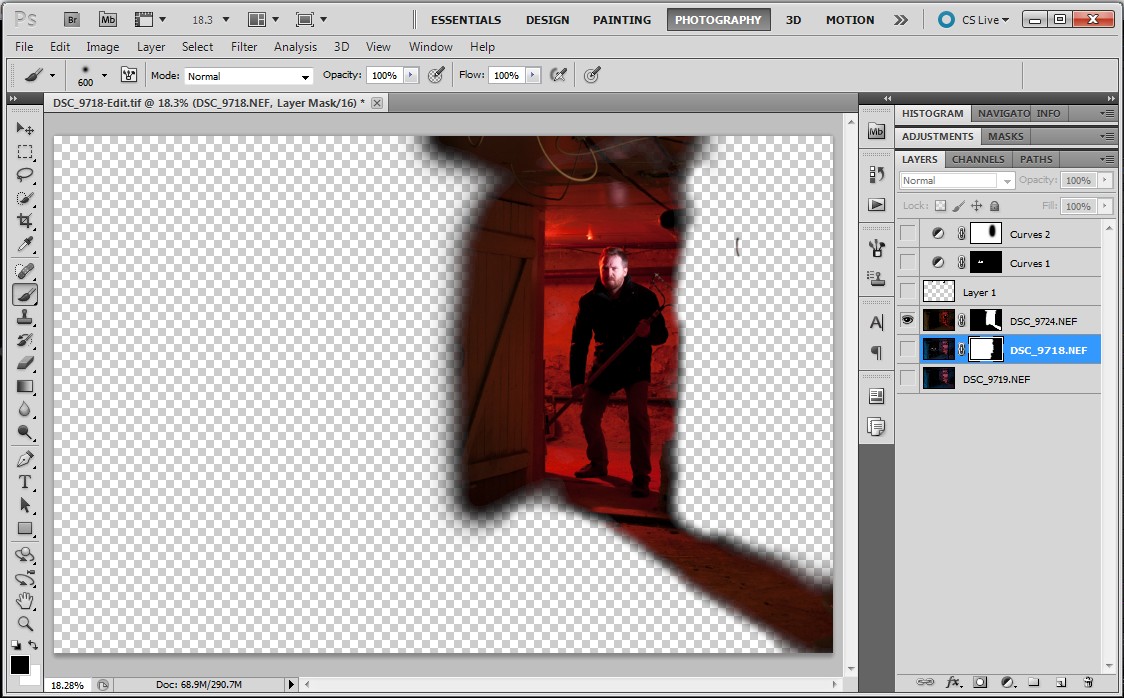
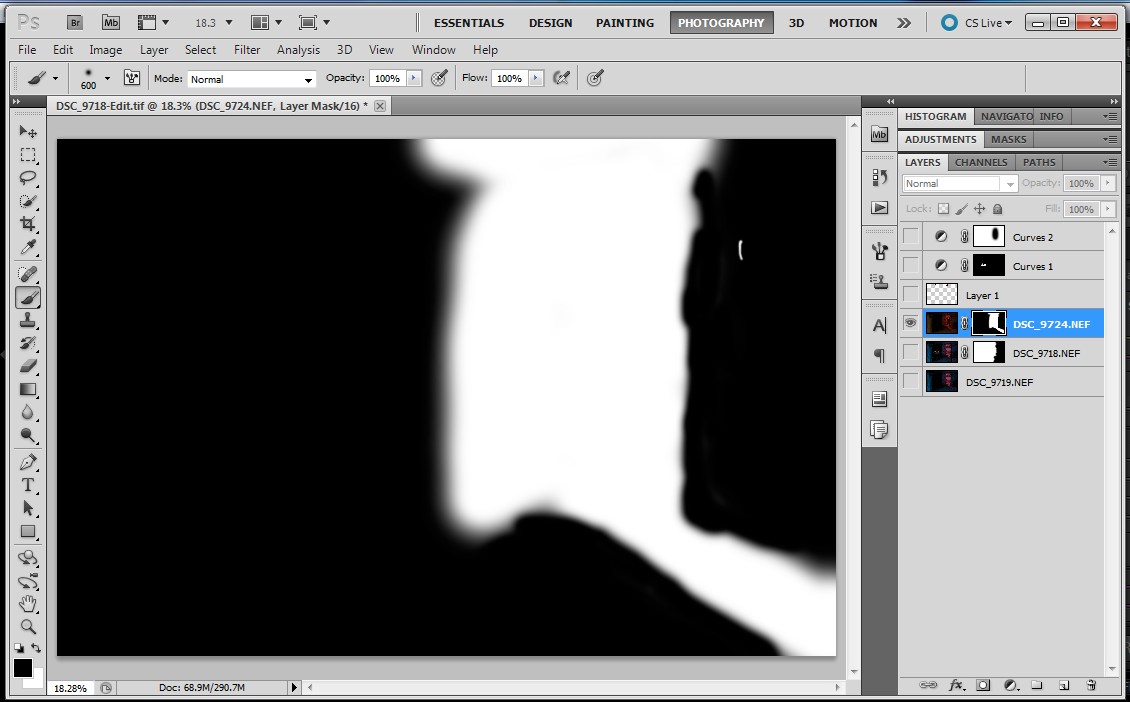
ScreenHunter_02 Jan. 11 16.42With the image of the blue room I adjusted the levels to get the brightness/contrast I wanted. I tuned the blue colour of the room with a white balance adjustment and the hue/saturation/luminance controls. I also used this control to reduce the red and orange saturation on my face.ScreenHunter_03 Jan. 11 16.44If you recall from the previous post I took a second image of the blue room with the snooted flash removed. I copied all of the adjustments from above over to this image. With the red room, I made minimal adjustments. I tweaked the white balance and increased saturation. I added some blacks to increase contrast.ScreenHunter_04 Jan. 11 16.46When finished in Lightroom I opened the three images as layers in a single Photoshop file in the following order: empty blue room > blue room with me > red room. I selected the three layers and used the Auto-Align Layers tool (in Automatic mode) to remove any misalignment from slight camera movements between shots. ScreenHunter_06 Jan. 11 16.52I masked off the right side of the “blue me” layer (to allow the underlying empty room to come through). The first image below is the resulting layer and the second image is the mask used to create it.ScreenHunter_05 Jan. 11 16.51ScreenHunter_08 Jan. 11 16.52The red room required a more complex mask to keep the red on the door and floor but not spill onto the door frame on the right side.ScreenHunter_09 Jan. 11 16.53 ScreenHunter_10 Jan. 11 16.53The three layers, when all visible, appear like this:ScreenHunter_10 Jan. 11 16.54My next step was to remove blemishes such as the smoke alarm in the blue room and some messy cables. For this I created a new layer above the three image layers. I set the healing brush and clone stamp tools to sample from all layers below. The edits appeared in the new layer, leaving the underlying layers untouched. This method makes the removal of healing/cloning edits much simpler because they can be deleted from the self-contained layer. Here is the layer containing the edits.ScreenHunter_11 Jan. 11 16.54As a final adjustment I added a curves adjustment, again as a new layer but masked off the red room.ScreenHunter_11 Jan. 11 16.55Here is the final image in Photoshop:ScreenHunter_12 Jan. 11 16.56Finally, I opened the image up in Lightroom and cropped on a slight angle to add a bit of drama.DSC_9718-Edit-5Thanks for reading!

The Making of a Scary Basement Photo

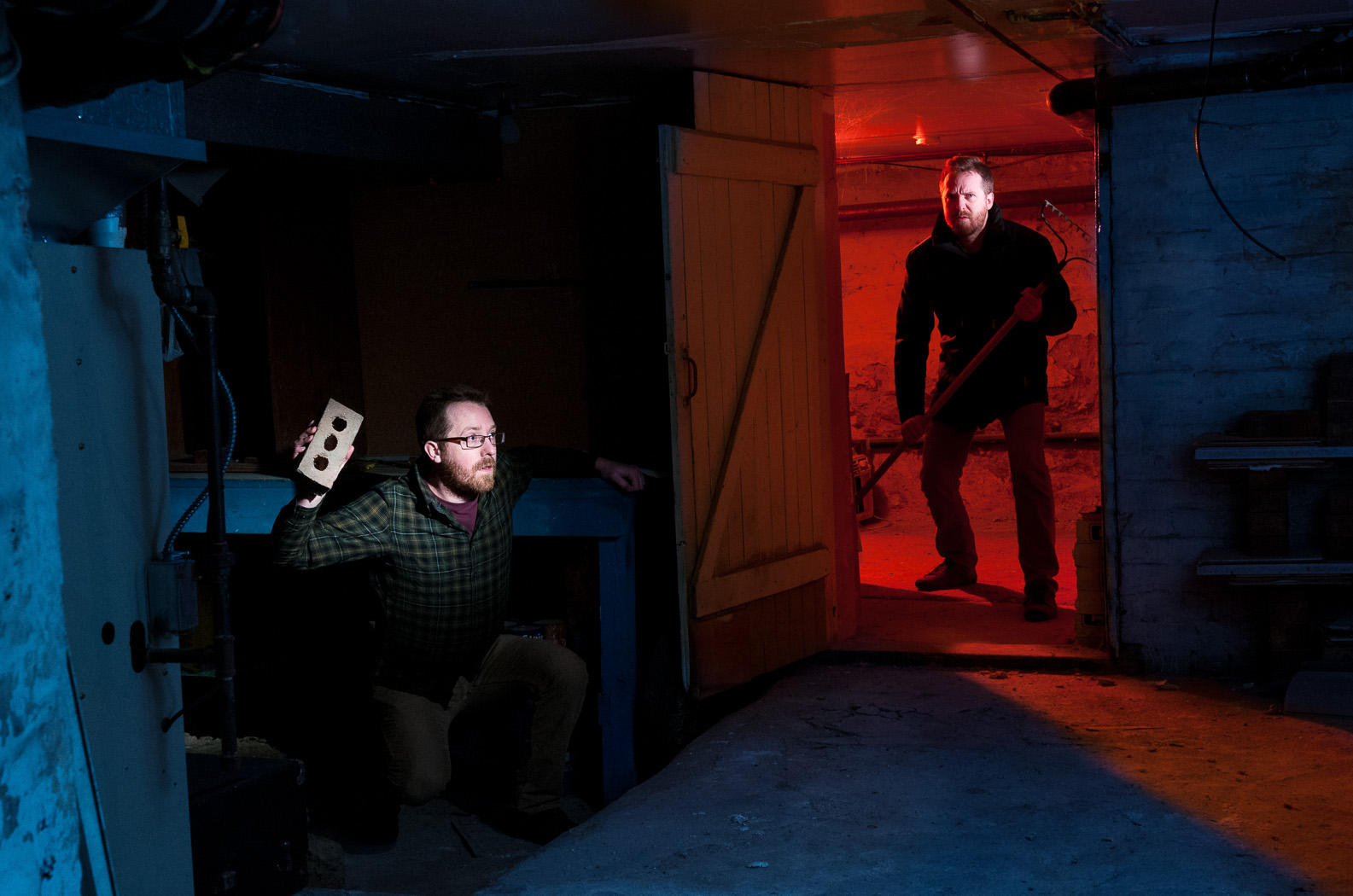
Here is my attempt at a “scary” basement photo… and double self portrait. In this post I’ll explain how I put it all together.
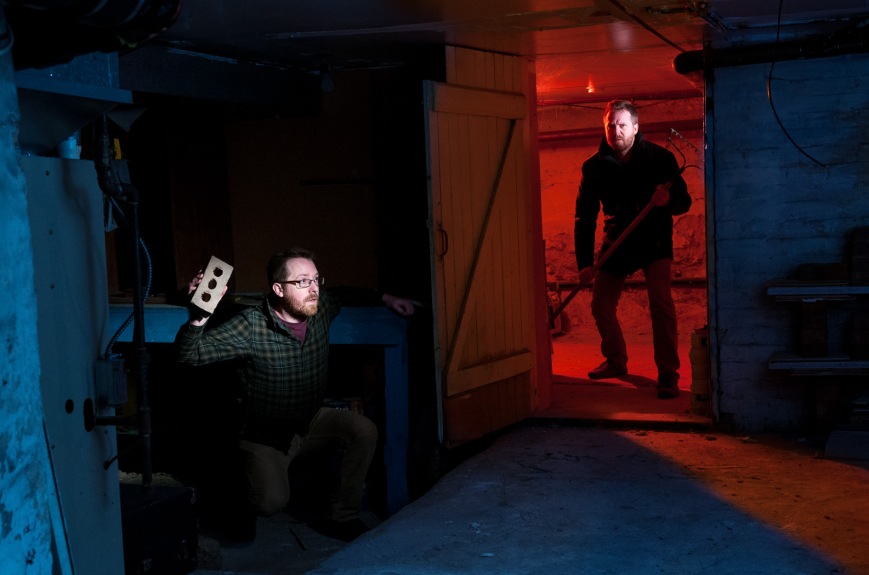
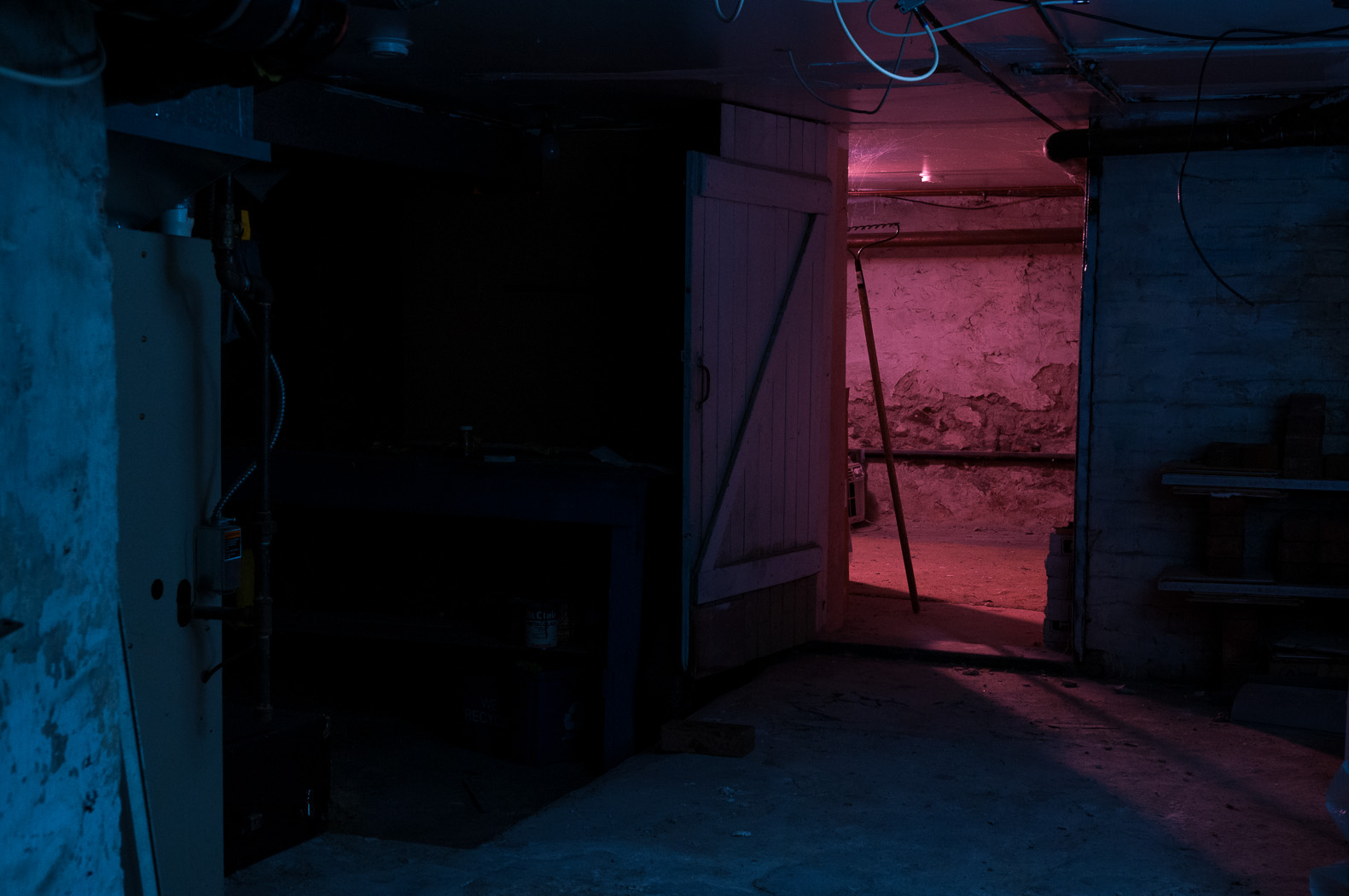
DSC_9718-Edit-5I’d been wanting to take a photo in my apartment’s basement for a while and was finally awarded some spare time this past week. I decided to do make the image over two nights, the first for setting up the lighting and the second for the final shots. This method gave me the time I needed to work out the lighting logistics without the stress of having to produce a result immediately. Another aspect to this image, one that is rare for me, is that I had the overall scene worked out in my head days before I actually went about doing it. I knew in advance that this would have to be a composite to include two versions of myself.

Not being someone who takes many photos with complicated lighting setups, I am limited in the equipment I have and this presented a few hurdles to overcome. Most importantly, while I own enough flashes (shoe mount and studio), I don’t have sufficient means to trigger them. I’ll get into this later.

Let’s start with the scene without any lighting. The basement is divided into three rooms and is creepy on its own.DSC_9668
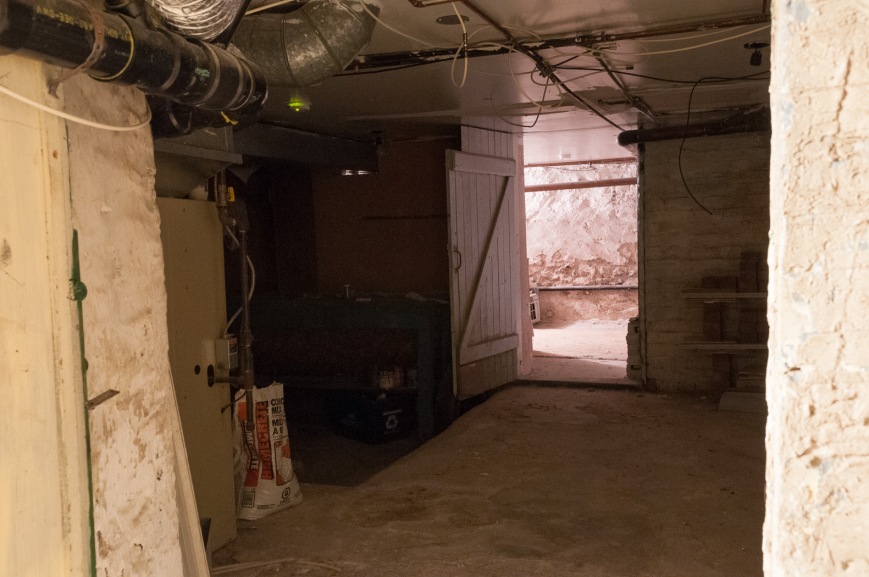
To start, I put the D300s on a tripod with the AF-S 17-55mm f/2.8 set to f/8, 1/160s, ISO 400. I marked the leg locations on the floor with tape because I knew I’d have to move the tripod away from the doorway overnight.

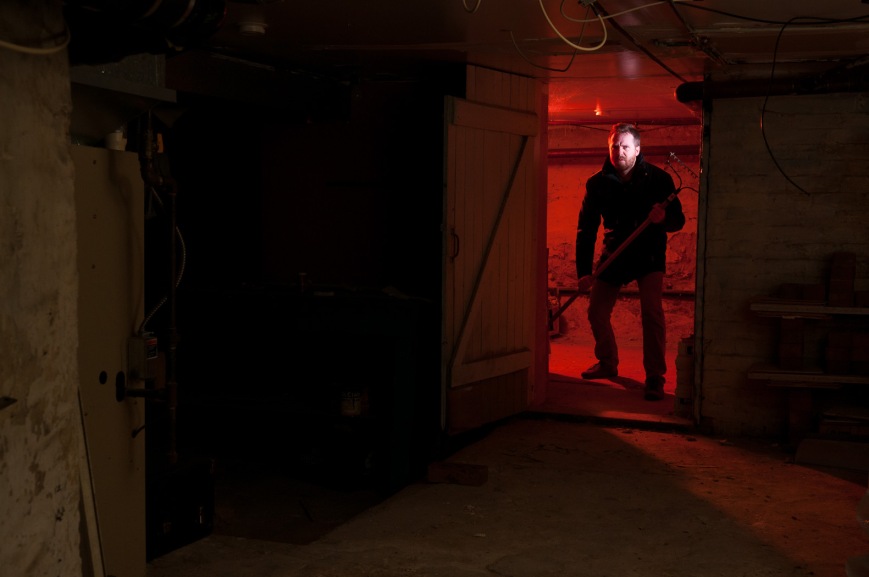
I lit the back room in red first using a Nikon SB-700 with a red gel. I added a diffuser cap, zoomed the flash out to 14mm and set it to 1/2 power to fill the room with red. I positioned the flash behind my right shoulder to give some rim light and as a fortunate consequence it projected a nice red spill onto the floor of the main room.

To make ‘evil me’ stand out I added a Nikon SB-900 with a light purple gel. I used a grid spot to keep the light on my face and not spill onto the ceiling or door frame. I kept the power at a low level of 1/16. I positioned the head of the rake within the spill of the gridded light to separate it from the red wash.DSC_9724I took the red room image with white balance set to Flash. For the main room, I wanted to have an overall blue feel to the fill. I pointed an Alien Bees B800 studio strobe into the inside corner of the room and set the camera’s white balance to Tungsten to turn the flash’s white output blue (an alternate approach would have been adding a blue gel to the flash and since making this photo I’ve picked up some gels to fit the Alien Bees’ 7′ reflectors, including a 1/2 CT blue).
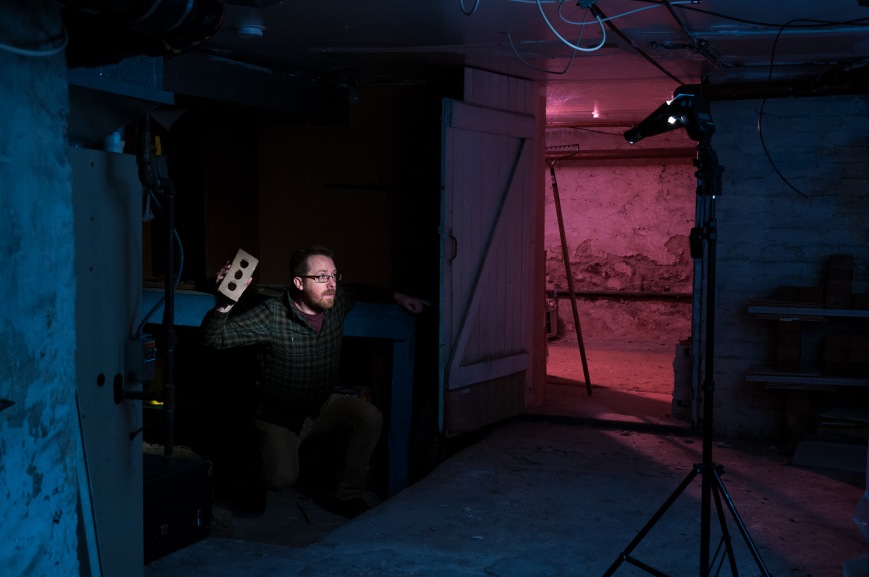
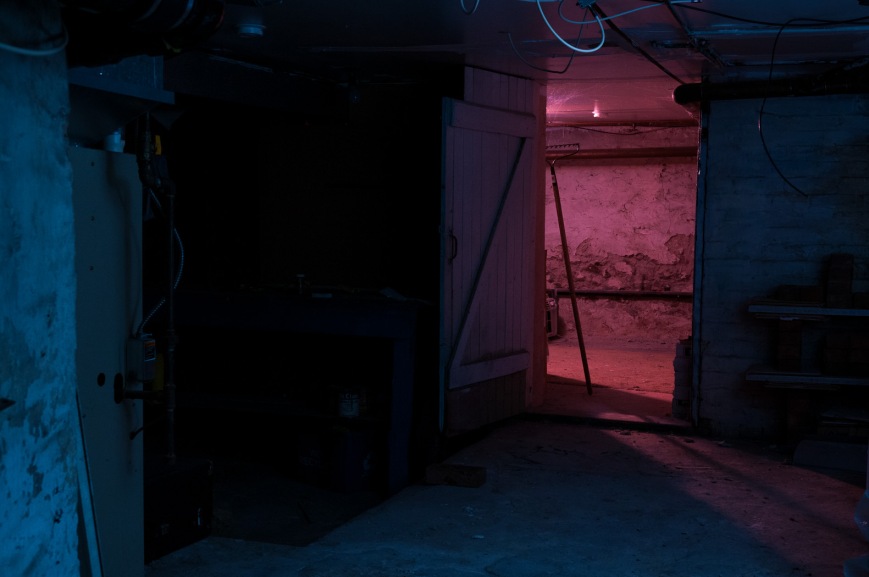
I lit ‘scared me’ with a snooted Metz 48 AF-1 at 1/8 power. I added a full CTO (orange) gel that, when combined with the Tungsten white balance on the camera, gave white light. The snoot was aimed to light just my upper body and the brick.DSC_9718In order to get the right coverage from the snooted flash I had to place it right in the middle of the frame. Another image, this time with the snooted flash removed, gave me the a clear view of that area.DSC_9719Here is the lighting diagram of the three images:
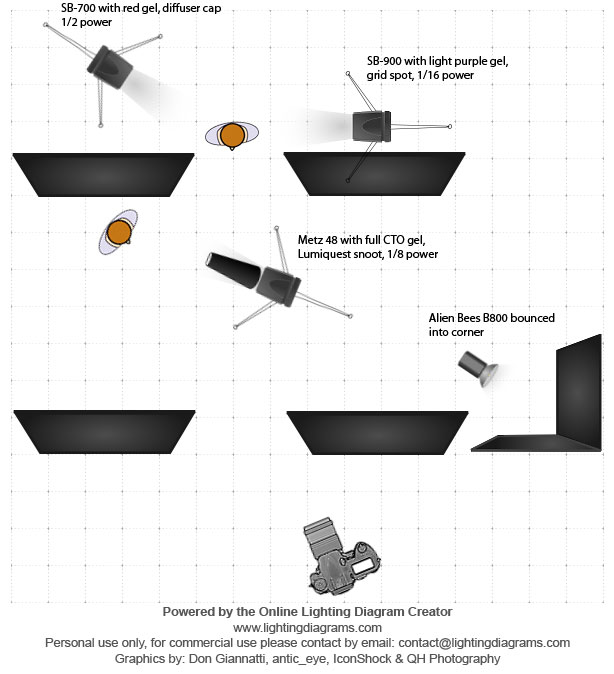
lighting-diagram-scary-basement For triggering the flashes, I had to think carefully. Three of these four flashes have optical slaves. Only two of them have connectors for wireless triggers. The Metz 48 AF-1 has neither (although since this shoot I updated the firmware to include optical slave). In the end put a wireless trigger (Cybersync) on a flash in each room and triggered the other two with their optical slaves. This made optical line of sight easy, as the two slaved flashes only had to see their nearby wirelessly triggered flashes.

I brought the three images into photoshop and masked out the unwanted areas. With some heal/clone work to remove unwanted wires and highlights and a final curves adjustment, the image was done!
Trying a New HDR Technique with 32-Bit TIFFs

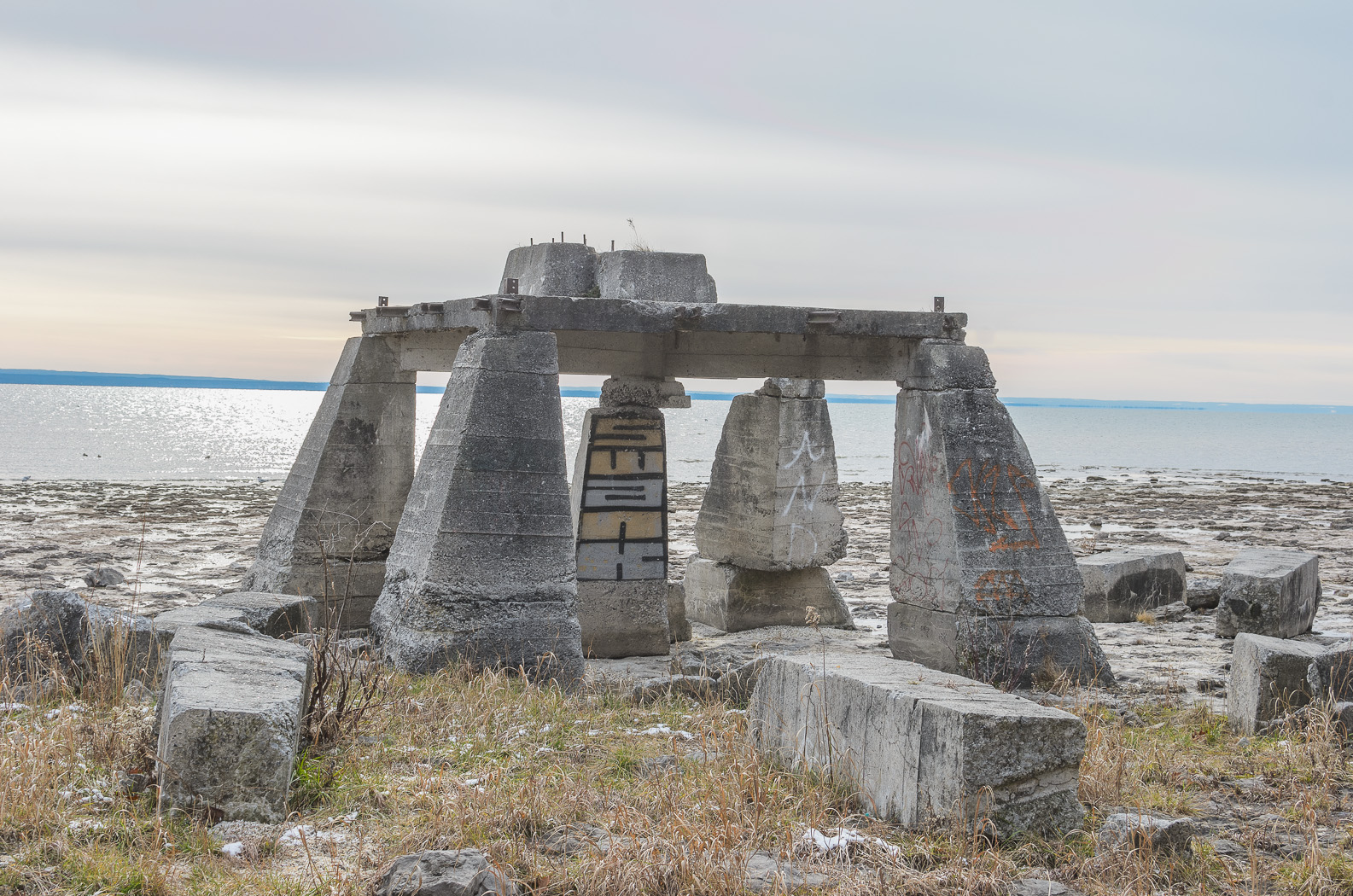
Today I came across a new high dynamic range (HDR) technique that combines Photoshop’s HDR tool with a feature that was included in the Lightroom 4.1 update that I hadn’t noticed before: the ability to edit 32-bit TIFF images. As a first attempt I processed this image (from a walk on the Lake Erie shore at Fort Erie on Christmas Eve):

DSC_9164-Edit-2The process I used was:

  • I took a series of images (minimum three) with different exposures to capture the full dynamic range of the scene. Using a tripod is best although the HDR tool in Photoshop automatically aligns the images. For the images used to create the HDR above I shot handheld with autobracketing on the D7000 for -1, 0 and +1 EV exposure compensation.
  • In Lightroom 4.1 (or newer) I did some minor tweaking of the images to prepare them for the HDR tool. First I applied automatic distortion, vignette and chromatic aberration corrections for the 35mm f/1.8 DX. Next I changed the calibration profile from ‘Adobe Standard’ to ‘Camera Neutral’ in order to reduce the contrast. Finally I adjusted the exposure settings to ensure that the darkest image included the full range of tones in the highlights and the brightest image covered the full range of tones in the shadows. The images looked like this:

DSC_9164 DSC_9165 DSC_9166

  • I exported the three images to the HDR tool in Photoshop using the ‘Merge to HDR Pro in Photoshop’ command and saved the resulting combined image as a 32-bit image. Note that Lightroom cannot read 32-bit PSD files so it is best to configure Lightroom to export as a TIFF to Photoshop.
  • With the new 32-bit file back in Lightroom I could begin editing. At first glance, the image doesn’t seem to have any more information in it than before the HDR conversion but that is because all 32 bits of data can’t be displayed at once.  Instead, it is best to think of the file as a RAW with an enormous amount of information in the highlights and shadows. Pulling the Shadows slider all the way to +100 and the Highlights slider to -100 and a reduction of the Exposure slider to taste gives the following image. This is a good demonstration of the amount of data present, but not quite a final image. 32-bit Quick AdjustWith some further tweaking in Lightroom (exposure controls, curves, saturation/vibrance, sharpening) I got reached this point:

DSC_9164-ColourAt this point I wasn’t too happy with the banding in the sky… something I’ll have to figure out for future images. In the end I opted to convert to black and white for a darker feel.

DSC_9164-Black and WhiteAnd there it is, a simple HDR technique that doesn’t use any of the tone mapping features of common methods. I prefer this approach to those with tone mapping primarily because I have full control over the edit.

On the Walter Bean Trail with Mitzy

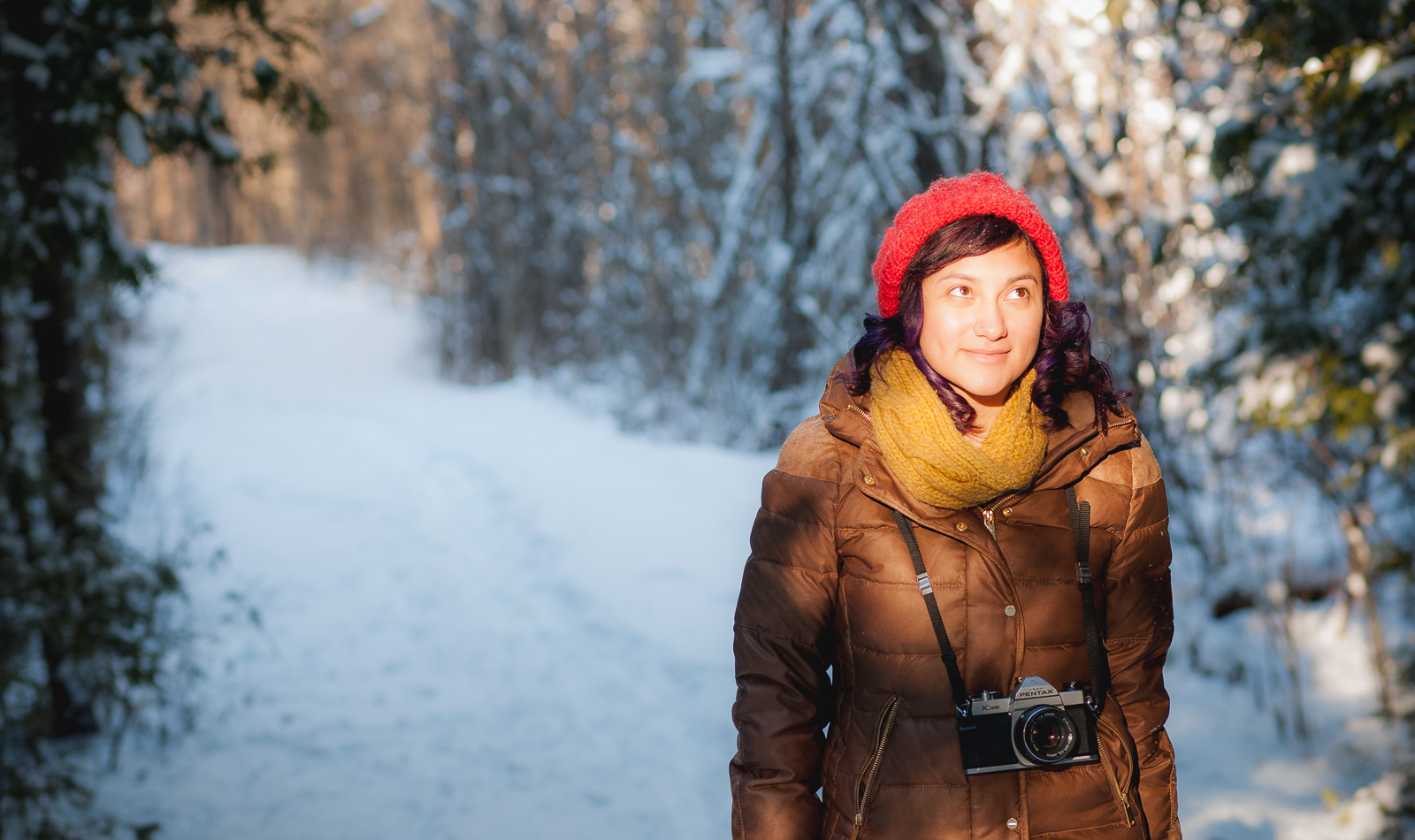
Mitzy and I went for a walk in the snow on the Walter Bean Trail last week. Despite being only 10 cm, it was still the biggest snowfall since March, 2011. Here are a couple of shots, both with cinematic crops that I feel work quite well.

First, one with the AF-S 85mm f1.8 G.  Mitzy was standing in a sunbeam poking through the trees. I’m finding this lens to have extremely accurate focus and wonderful subject separation. This is at f/4 and Mitzy still pops from the background. The bokeh is still great at f/4 as well. Unfortunately I overexposed her face, leading to some poor skin tones when I recovered the highlights.

DSC_9600Next is a manually focussed shot with the 35mm f/1.8 DX at f/1.8.

DSC_9623

Thanks for looking!

Mitzy with her Foxes in the Sumac

Here’s a shot from a couple months ago during a visit to my Dad’s in Inglewood, ON. I thought it would be a good image to try out some newly discovered retouch techniques. I’m sure at some point I’ll write about them.

Taken with the D300s and Sigma 50mm f/1.4 at f/2.5.